Tokyo has a way of offering up cultural moments that feel almost too well timed. In early 2026, two exhibitions arrived in the city that shared the same obsession — the relationship between the human body, technology, and beauty — approached from different angles by two of Japan’s most singular creative visions. I attended both, and between them they gave me a lot to think about.
This post is mainly about one artist: Hajime Sorayama (空山基). But it’s also about the moment his work appeared inside a Ghost in the Shell exhibition and made the whole room make sense.
Who Is Hajime Sorayama?
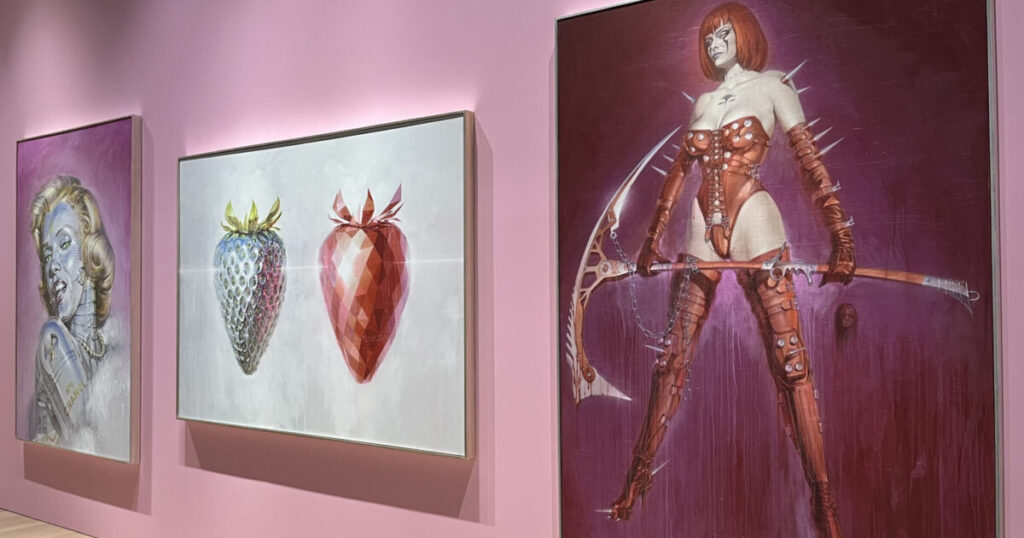
Born in Ehime Prefecture in 1947, Sorayama is one of the most distinctive visual artists Japan has produced. His signature work — the Sexy Robot (セクシーロボット) series, begun in 1978 — depicts hyper-realistic chrome-plated robot figures rendered with extraordinary technical precision. The surfaces gleam. The reflections are physically accurate. Every curve of light and shadow is deliberate and controlled.
But calling Sorayama simply an illustrator of robots undersells him considerably. His practice is fundamentally about light — specifically, how light behaves on reflective metallic surfaces. To paint that, he says, you must also paint air. To paint air, you must master transparency. And to master transparency, you must understand reflection. It is a pursuit that has defined his entire career, and one that few artists have ever attempted at this level.
His influence has been enormous and far-reaching. He designed the original Sony AIBO (アイボ) entertainment robot dog. He created the iconic Aerosmith album cover art. He has collaborated with Dior, BAPE, New Era, and many others. He has left a mark on science fiction, fashion, and industrial design. And through all of it, his work has remained unmistakably, irreducibly his own.
The Sorayama Retrospective: Light, Transparency, Reflection
SORAYAMA: Light, Transparency, Reflection —TOKYO— runs from March 14 to May 31, 2026, at Creative Museum Tokyo in Kyobashi, Chuo-ku. Organised by NANZUKA, the gallery that has represented Sorayama for years, it is his largest retrospective ever — and it delivers on that description completely.
The exhibition traces the arc of his work from a 1978 robot painting created for a whisky advertisement all the way through to his newest large-scale sculptures and video installations. Spanning nearly five decades, it makes clear just how consistently and how deeply Sorayama has pursued his central ideas — and how those ideas have continued to evolve.
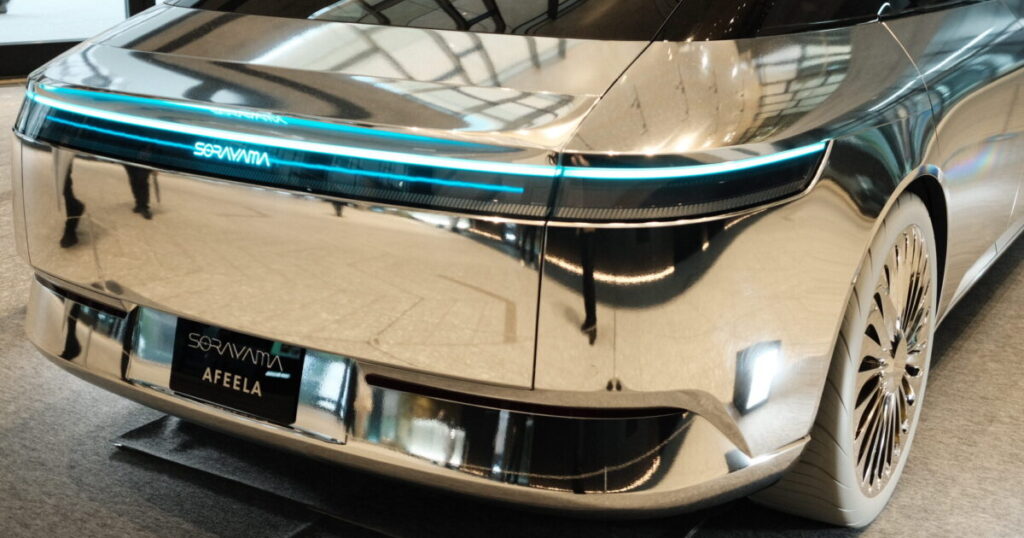
The first thing that greets you at the entrance is not a painting or a sculpture — it’s a car. Sony Honda Mobility’s AFEELA (アフィーラ), reimagined as an art object in collaboration with Sorayama, sits at the threshold of the exhibition like a statement of intent. Chrome aesthetics applied to a vision of future mobility — it sets the tone immediately and makes clear that this is an artist whose influence extends far beyond the gallery wall.
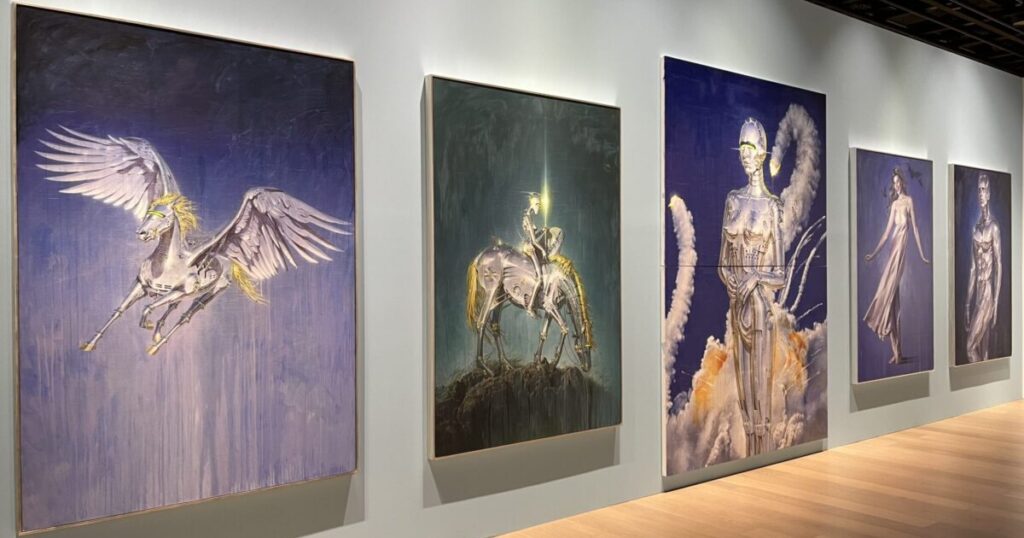
Walking through the exhibition felt like moving through a complete artistic mind, beginning with The Gallery — a striking opening section where past works were reconstructed from archival data, printed at high resolution onto large canvases, and then reworked by Sorayama himself with additional brushwork. It’s a fascinating process: digital and analogue in the same breath, old work made new again by the artist’s own hand.
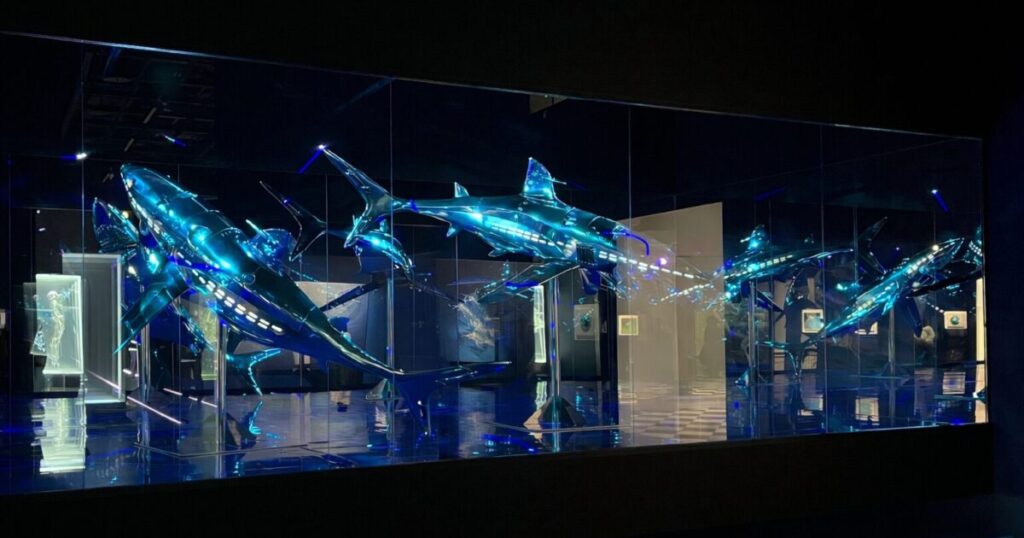
From there, the Aquarium section presents his iconic shark sculpture in a tank-like environment. Sorayama has described the shark as “the sexiest fish,” and seeing it surrounded by related paintings makes the development of that idea over decades immediately legible.
The Mirror Maze installation followed — reflective sculptures enclosed within mirrored surfaces that multiply their forms infinitely, immersing visitors in a labyrinth of light and reflection. Standing inside it, perception becomes genuinely unstable. It’s the kind of installation that cannot be adequately photographed, which is a mark of something well designed.
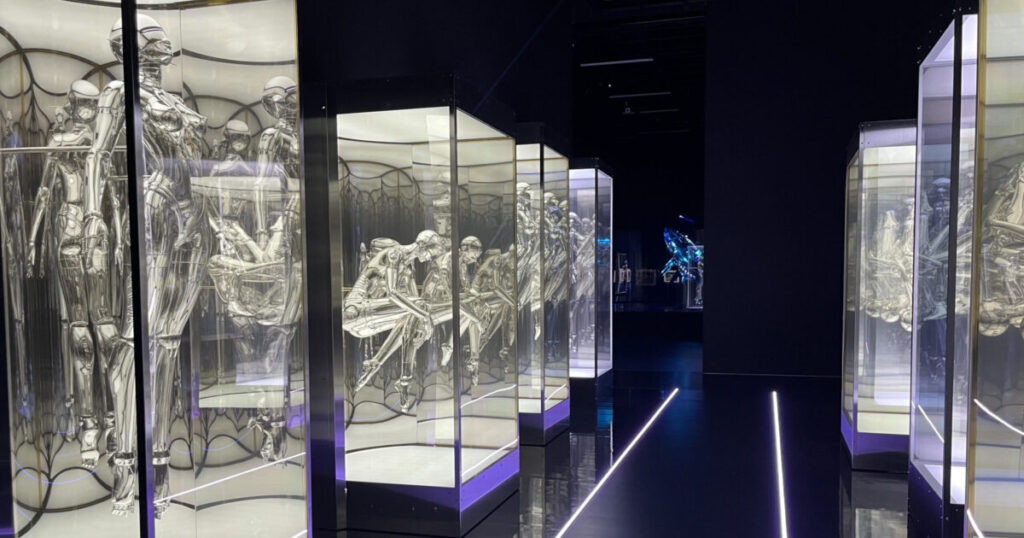
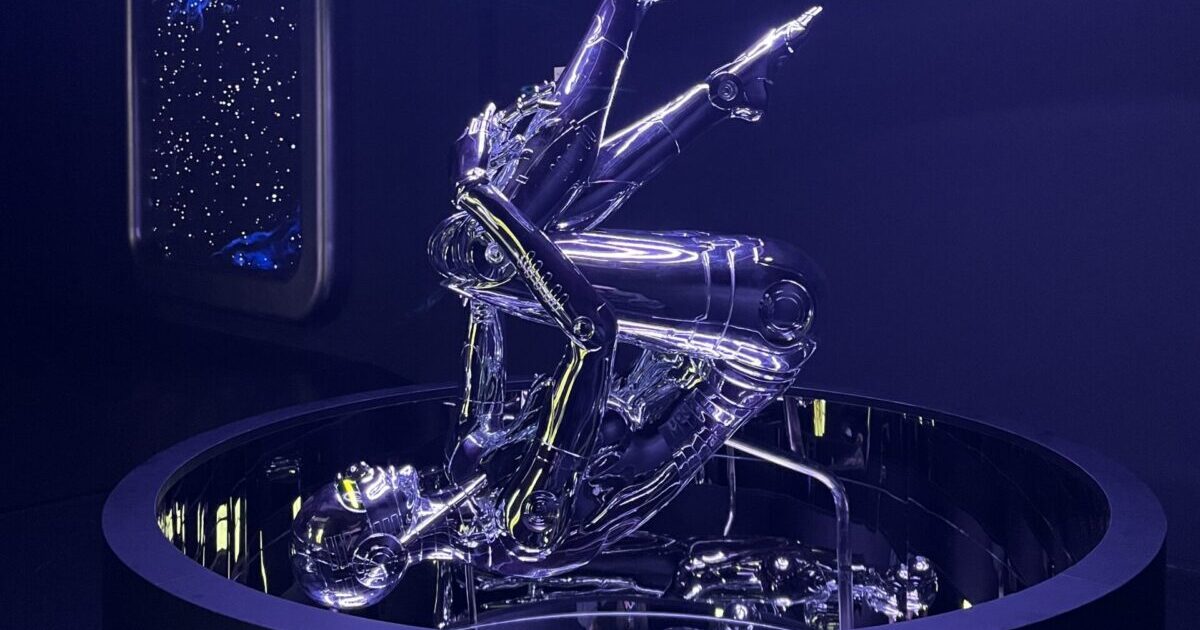
After the Mirror Maze, one piece stopped me in a different way — a figure clearly inspired by Motoko Kusanagi (草薙素子), the cyborg protagonist of Ghost in the Shell. Chrome, female, unmistakably Sorayama’s hand. Knowing that a counterpart figure was displayed at the Ghost in the Shell exhibition across town made the moment feel deliberately orchestrated — two exhibitions in conversation with each other, connected by a single figure.
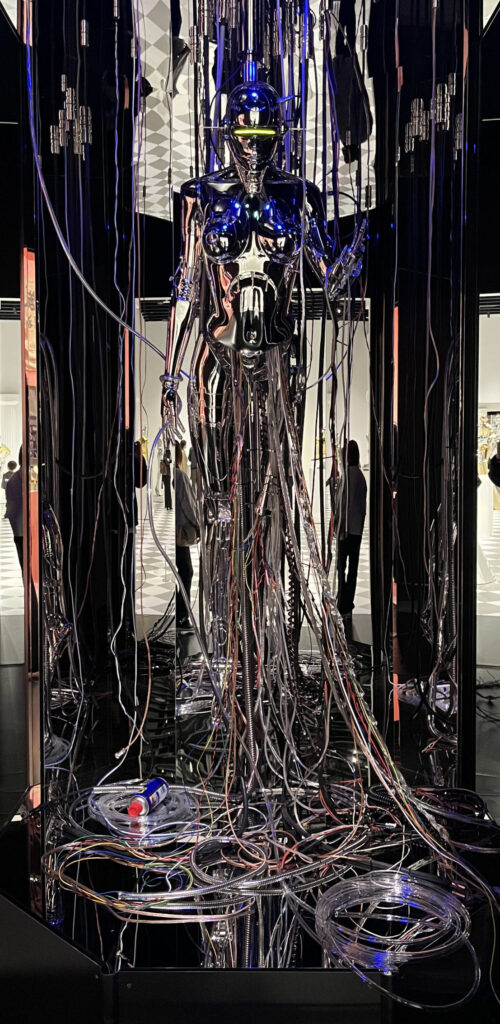
Ghost in the Shell: The Exhibition
Ghost in the Shell: The Exhibition ran from January 30 to April 5, 2026, at Tokyo Node Gallery in Toranomon Hills, Minato-ku — the first large-scale exhibition to cover the entire history of the Ghost in the Shell (攻殻機動隊, Kōkaku Kidōtai) anime franchise.
The centrepiece was an archive of over 1,600 items — original drawings, storyboards, background paintings, and production materials spanning the entire run of the franchise, many never shown publicly before. Works by directors including Mamoru Oshii, Kenji Kamiyama, Kazuchika Kise, and Shinji Aramaki were all represented. Seeing the raw production materials — the handwritten storyboard notes, the density of the background art — made the franchise’s visual ambition feel even more astonishing than it does on screen.
Sorayama × Ghost in the Shell: The Sexy Robot
The moment that stopped me completely at the Ghost in the Shell exhibition was a Sorayama Sexy Robot (セクシーロボット) — a large-scale chrome sculpture displayed within the exhibition space.
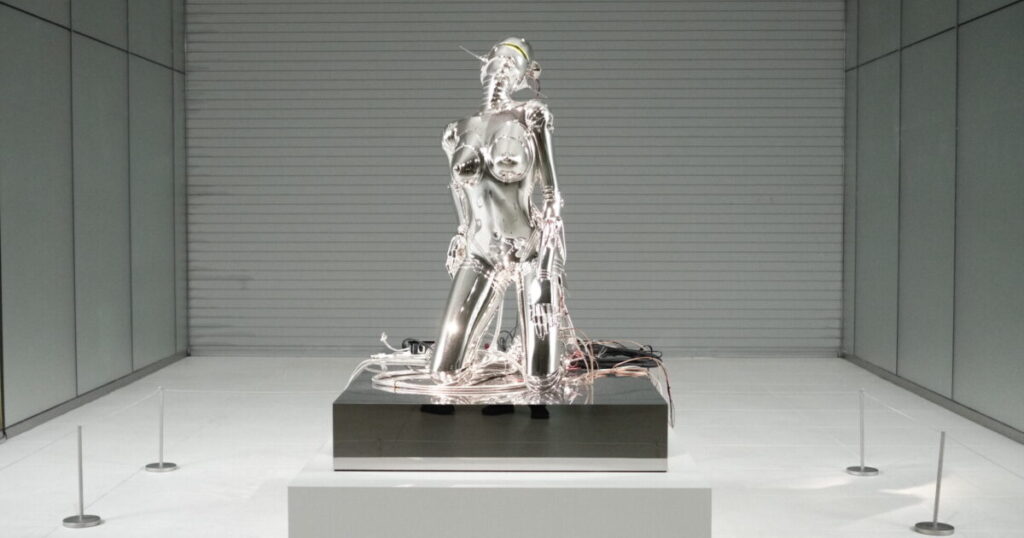
Its presence was both unexpected and entirely fitting. Ghost in the Shell and Sorayama have always shared the same aesthetic and philosophical DNA. Both are preoccupied with the relationship between the human body and technology. Both are fascinated by surfaces, reflections, and the visual language of the machine. Both ask, in their own way, what it means to be alive inside a shell that isn’t entirely your own.
Motoko Kusanagi (草薙素子) — the cyborg protagonist of Ghost in the Shell — is in many ways the narrative embodiment of what Sorayama has been painting since 1978. A consciousness inside a chrome body. A ghost inside a shell. Seeing his sculpture inside that exhibition space felt less like a collaboration and more like a recognition — two expressions of the same obsession, finally in the same room.
What I Bought
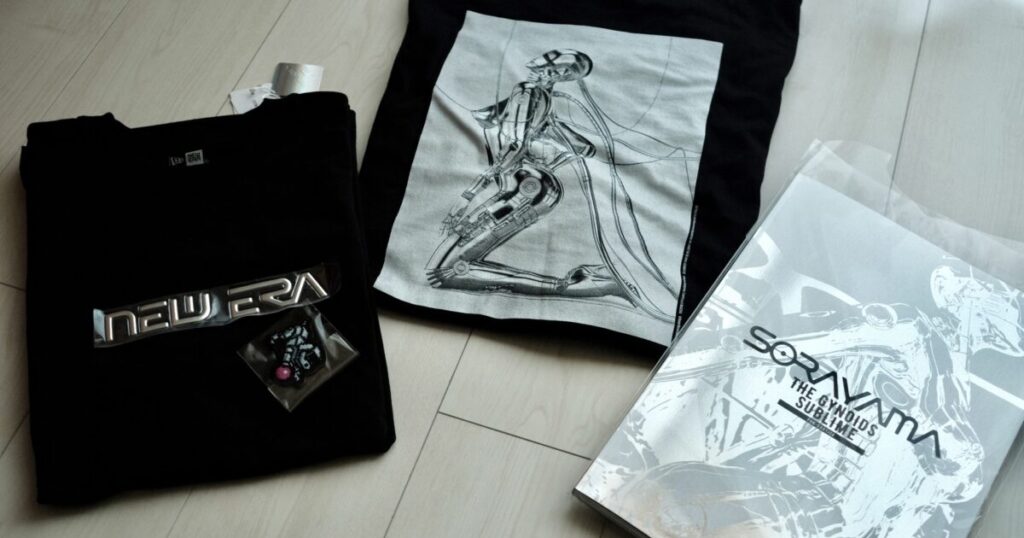
Between the two exhibitions, I came home with a few things worth mentioning. At Creative Museum Tokyo, I picked up a collaborative t-shirt with New Era — heat-bonded branding from both New Era and Sorayama, understated in its execution and immediately recognisable to anyone familiar with his aesthetic. I also bought a book from the retrospective. His paintings need to be seen at a certain scale and with a certain fidelity to understand what makes them remarkable, and the publication comes closer to that than anything you’d find on a screen. At the Ghost in the Shell exhibition, I picked up a t-shirt featuring a Sexy Robot print — available exclusively at the venue. It connects the two worlds on a single object, and wearing it feels like carrying a small piece of that moment at Toranomon Hills.
Final Thoughts
If you are in Tokyo before May 31, 2026, the Sorayama retrospective at Creative Museum Tokyo is not to be missed. It is a rare opportunity to experience the full arc of an extraordinary artistic career in one space — and to understand why his work has resonated so widely across art, design, fashion, and science fiction for nearly fifty years. The Ghost in the Shell exhibition has now closed, but the questions it raised have not.
Creative Museum Tokyo is located at TODA Building 6F, 1-7-1 Kyobashi, Chuo-ku, Tokyo. The Sorayama retrospective runs until May 31, 2026.